Free template: data room checklist
What should be in a seed data room? A checklist to copy
A seed data room holds six groups of documents: company and legal, cap table and earlier rounds, financials and plan, product and technology, customers and traction, and team. The checklist below lists each document and what an investor looks for in it.
Updated
The checklist
Company and legal
| Document | What an investor looks for |
|---|---|
| Certificate of incorporation and articles | That the company exists, where it is registered and who can sign for it. |
| Shareholder agreement and any side letters | Rights that bind a new investor: vetoes, preferences and transfer limits. |
| Board and shareholder resolutions | That past decisions, earlier share issues among them, were made properly. |
| List of group companies and where each is registered | Which company holds the IP, the contracts and the team. |
| Disputes, claims and letters from regulators, or a note that there are none | Anything open that could land on the company after the round. |
Cap table and earlier rounds
| Document | What an investor looks for |
|---|---|
| Cap table with every shareholder, share class, SAFE and convertible note | Who owns what today, and after everything converts. |
| Documents of earlier rounds: SAFEs, notes and subscription agreements | The terms already promised: caps, discounts and preferences. |
| Option pool, grants and vesting schedules | How much is promised to the team and how much is left. |
| Terms of this round: amount, instrument and what is already committed | What is on offer and who else is in. |
Financials and plan
| Document | What an investor looks for |
|---|---|
| Management accounts for the last 12 months, or since the company started | Revenue, costs and burn month by month, in the company's own numbers. |
| Financial plan to the next round, with its assumptions | What the money is for, and what has to be true for the plan to hold. |
| Cash position today, with a bank statement | How much cash there is and how long it lasts. |
| Loans, grants and other obligations | Anything that has to be repaid or comes with conditions. |
| Latest tax filings and annual accounts, if any were filed | That filings are up to date and agree with the management accounts. |
Product and technology
| Document | What an investor looks for |
|---|---|
| The deck used in this round | The story the founders tell, to check the rest of the data room against. |
| Product description or access to a demo | What exists today, as opposed to what is planned. |
| Product roadmap | What the team will build with this round. |
| IP assignment agreements for founders, employees and contractors | That the company, not a person, owns what was built. |
| Patents, trademarks and domains, filed or registered | What is protected, and in whose name. |
| Open-source and third-party components the product depends on | Licences or suppliers that could limit the product. |
Customers and traction
| Document | What an investor looks for |
|---|---|
| Top customer contracts or letters of intent | Who has signed, for how long and on what terms. |
| Monthly revenue or usage, by cohort where there is enough history | Whether customers stay and grow, not only how many signed. |
| Sales pipeline | What is likely to close next, and how the team counts it. |
| Customer references | People an investor can call. |
| Main sales channels and what they have cost so far | Where customers come from. |
Team
| Document | What an investor looks for |
|---|---|
| Founder CVs | What each founder did before, and who does what now. |
| Founder and employee agreements | Vesting, notice and non-compete terms for the people the company depends on. |
| Team list with roles, start dates and employee or contractor | Who works on the company today. |
| Key hires planned | Which roles this round pays for. |
If you are a founder preparing one
- Copy the checklist and strike the lines that don't apply to your company yet. Say so in the data room, so a gap doesn't read as something hidden.
- Keep one folder per group, named as in the checklist, with a date in each file name.
- Add a one-page index: what is in the data room and what is still to come.
- Share it view-only, and update the data room itself instead of emailing new versions.
If you are a fund checking one
- Go through the checklist group by group and mark each line: there, missing or not applicable.
- Check the cap table against the documents of earlier rounds, and the deck against the accounts.
- Send the founders one list of what is missing, not five emails.
- When an updated data room arrives, look at what changed before you re-read everything.
How Neither helps a fund check a data room
- Drop the files, folders or a .zip on the startup's Documents tab, or paste a Google Drive, Dropbox, OneDrive or SharePoint link.
- Neither files each document by kind (pitch deck, financials, cap table, legal, IP, contracts, team, product, market), writes one line on what it is and reads it into the profile.
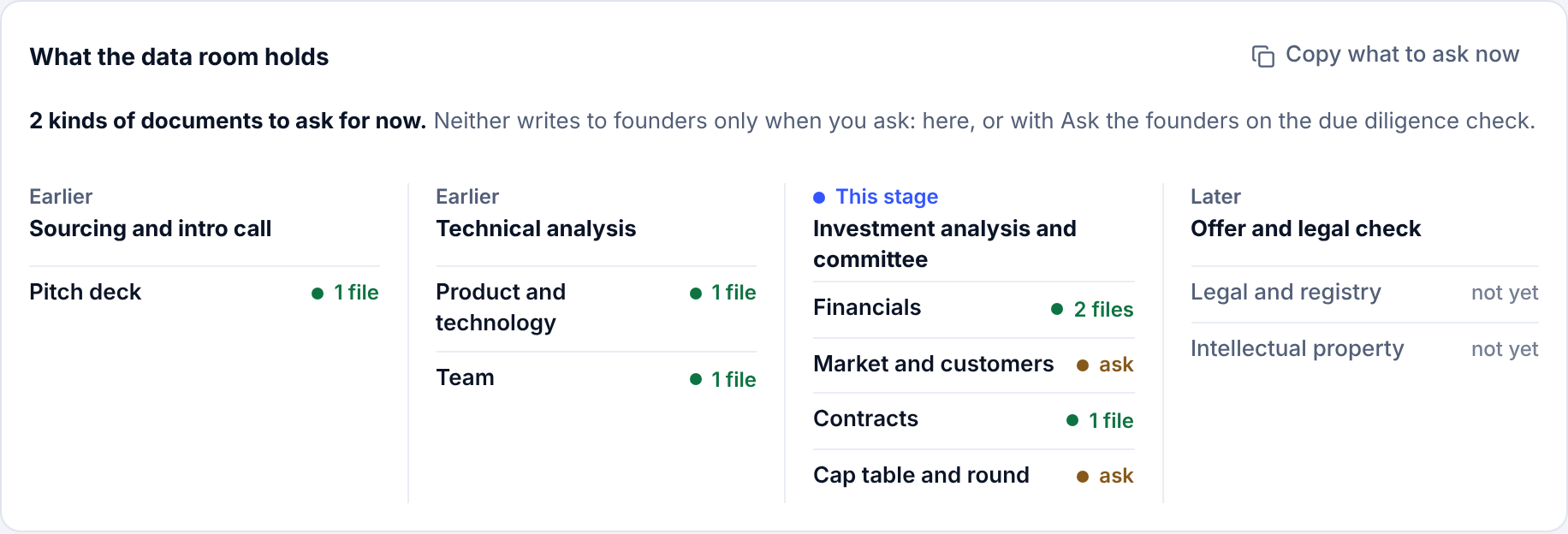
- The Documents tab shows which kinds of documents the data room holds and which to ask for at the startup's current stage. Copy that list and send it to the founders yourself.
- When a newer data room arrives, the profile is updated and says in a few lines what changed.
Neither builds the record. You meet the founders and decide.
Questions
How is a Series A data room different?
It has the same six groups with more history in each: more months of accounts, more signed contracts, longer cohort data and a bigger team to document. Start from this checklist and add to it.
Should the deck be in the data room?
Yes. Put in the version you are using in this round. Investors check the rest of the data room against it.
When should a founder open the data room?
Have it ready before you start the round, and open it when an investor asks after the first conversations. A data room that takes weeks to put together slows the round.
How do investors keep track of what is still missing?
With a copy of a checklist like this one for each startup, marking each line. In Neither the Documents tab shows which kinds of documents a data room holds and which to ask for at the current stage.
Does Neither ask founders for missing documents?
No. It lists what is missing. You ask.
Try it on one deck
Sign up with Google, add one deck and see the startup's profile fill in.
More work Neither takes off a fund
Use cases
- Pitch decks become startup profiles
- A data room filed and read for you
- Quarterly reports read and tracked